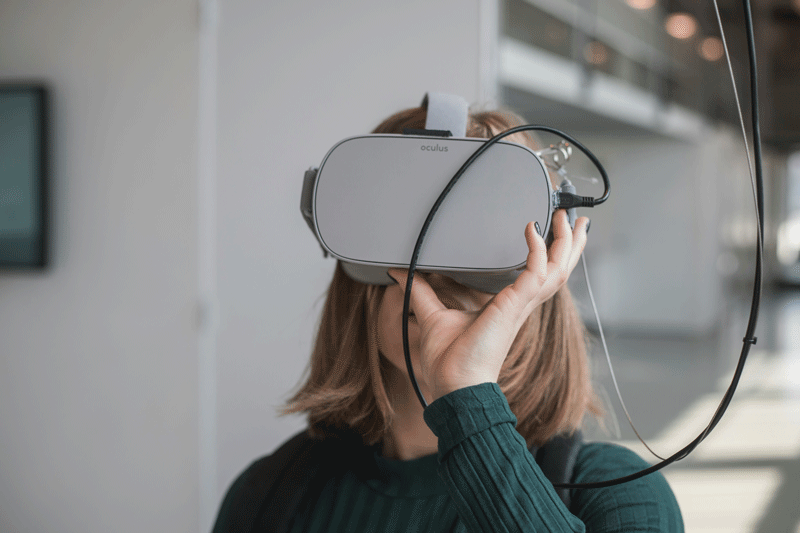
Ten years ago, if you’d told an Australian physiotherapist or occupational therapist that part of their job would involve fitting patients with virtual reality headsets, they probably would’ve laughed. Yet today, virtual reality (VR) rehabilitation is becoming part of standard care to support physiotherapy, cognitive rehabilitation and stroke recovery. For clinicians, this has opened up an entirely new type of role that didn’t exist a decade ago. VR rehab helps patients practise movement and daily tasks in simulated environments. We take a look at how VR physiotherapy, VR cognitive rehab and VR stroke therapy are reshaping allied health careers in Australia, and what it’s really like to step into the world of technology.
In clinical settings, VR rehab programs are designed by clinicians and researchers to target specific rehabilitation goals, such as improving balance, retraining arm and hand function, or building memory skills. Tasks can be graded in difficulty, repeated as often as needed, and adapted to each patient’s ability.
Subscribe for FREE to the HealthTimes magazine
https://www.youtube.com/watch?v=j0P6rSMhP0A
In Australia, VR rehab is being used across several allied health areas:
-
Physiotherapists use VR to support balance training, gait retraining and pain management.
-
Occupational therapists and neuro clinicians apply it to cognitive rehabilitation, visual-spatial skills and functional task practice.
-
In stroke therapy, VR allows patients to repeat meaningful movements and activities that encourage neuroplasticity.
VR rehab is usually delivered alongside traditional therapy, not instead of it. The technology simply becomes another tool to increase engagement, motivation and therapy intensity in ways that weren’t possible before.
Virtual reality rehabilitation hasn’t taken off by accident. Australia’s ageing population, rising stroke rates and increasing prevalence of neurological conditions mean more people need rehabilitation, often over longer periods. At the same time, services are under pressure to do more with limited staff and funding. VR allows clinicians to deliver high-repetition, goal-based therapy in a way that keeps patients motivated and engaged.
In physiotherapy, repetition matters, but keeping patients motivated to repeat the same movements over and over can be one of the hardest parts of rehab. This is where virtual reality has found a natural fit.
Patients might practise balance by navigating a virtual pathway, improve gait by stepping through simulated environments, or work on upper-limb strength by reaching, grasping and interacting with virtual objects. These tasks are designed to mirror real-world movements, while feeling more engaging and fun.
Importantly, VR physio isn’t a “set and forget” system. Physiotherapists still assess movement quality, adjust difficulty, ensure safety and link virtual tasks back to real-life function. The technology supports clinical decision-making rather than replacing it.
Virtual reality is also reshaping how cognitive rehabilitation and stroke therapy are delivered. Patients can practise skills such as attention, memory, problem-solving and executive function within simulated everyday environments. They might navigate a virtual supermarket, organise objects in a kitchen, or respond to visual and auditory cues.
Australian research has shown growing support for VR in neuro rehabilitation, particularly when used alongside conventional therapy rather than as a replacement. Organisations such as
Stroke Foundation Australia continue to highlight innovation in stroke recovery and rehabilitation approaches.
As VR rehabilitation becomes more mainstream, entirely new allied health roles are starting to appear across Australia. Physiotherapists, occupational therapists, exercise physiologists and speech pathologists are working in hybrid positions where they deliver therapy, adapt VR programs and help shape how technology is used safely and effectively.
The biggest surprise for many? Realising that using VR doesn’t make them “less clinical”. It simply gives them another way to deliver evidence-based care that feels aligned with the future of allied health, without losing the human connection.
Rather than narrowing career options, VR rehab can widen them. It opens pathways into leadership, research and digital health innovation, all while keeping patient care at the centre. VR rehab offers a future-focused career that’s likely to expand alongside Australia’s rehabilitation needs. It creates space for creativity, variety and problem-solving, while remaining firmly grounded in evidence-based care. And as Australia’s rehabilitation needs continue to grow, roles that blend clinical expertise with digital tools are likely to become even more relevant.