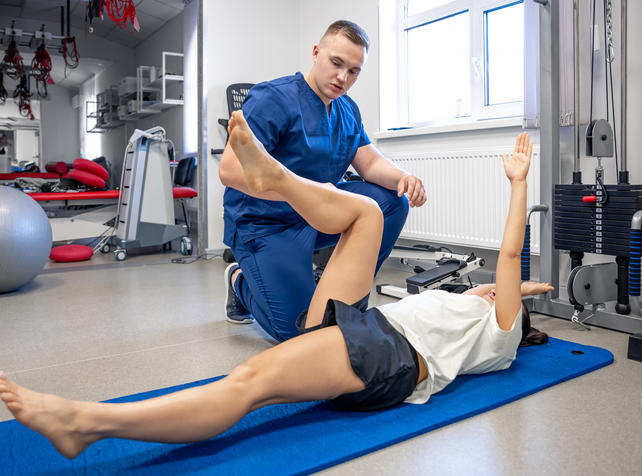
Most physiotherapists working in community sport do not have access to force plates, motion capture systems or GPS tracking units. This article makes the case for what skilled observational assessment can tell you, and how to get the most from the tools already in your clinic.
Ask a physiotherapist working in community sport what their movement assessment toolkit looks like and the answer is usually the same: a treatment table, some floor space, and a trained eye. The gap between what the research literature describes and what is available in a typical community clinic or local sporting club has always been wide. High-end facilities may have three-dimensional motion capture, instrumented treadmills and force plates embedded in the floor. For the vast majority of Australian physiotherapists managing sporting injuries day to day, whether that is the private practitioner covering a local football club, or the clinician running a busy outpatient caseload, those tools are simply not part of the picture.
Subscribe for FREE to the HealthTimes magazine
This creates a risk. When the research literature emphasises technology-driven assessment and clinicians lack access to those tools, there is a temptation to either skip formal movement assessment altogether or to feel that what can be observed with the naked eye is not rigorous enough to act on. Neither position serves patients well.
The reality is that skilled observational assessment, applied systematically and with clinical purpose, remains one of the most practical and meaningful tools available. The key is knowing what to look for, being honest about its limitations, and using a small number of well-chosen tests rather than trying to replicate what a laboratory can do.
What Observational Assessment Can and Cannot Tell You
It is worth being clear about the evidence base. Despite the advantages of instrumented systems,
quantitative gait analysis remains largely associated with research institutions and is not well leveraged in clinical settings, primarily due to the high cost and complexity of equipment, with observational assessment and qualitative scales continuing to predominate in everyday clinical practice. That is not purely a resource problem. It also reflects a practical reality that most patient encounters happen in environments where technology is limited and time is constrained.
The reliability of observational gait analysis is generally considered poor to moderate, and its validity is low compared to instrumented systems, which is a legitimate limitation to acknowledge. However, this does not mean observational assessment is without value. Its clinical utility lies not in producing precise kinematic data but in identifying meaningful movement patterns, guiding treatment decisions, and tracking change over time within the same clinician-patient relationship. Used consistently and with a structured approach, it informs good clinical reasoning even when it cannot match a laboratory's measurement precision.
The Single-Leg Squat: A High-Value Starting Point
For lower limb assessment in sports populations, the single-leg squat is one of the most widely used and well-studied observational tools available to clinicians.
A review and meta-analysis published in BMJ Open Sport and Exercise Medicine confirms it is a functional movement test widely used in clinical practice to visually assess lower extremity movement quality, offering information on strength, balance and neuromuscular control during functional activities.
What makes it useful in a community clinic setting is that it requires no equipment, takes less than two minutes to administer, and generates clinically meaningful information across multiple segments simultaneously. When observing the single-leg squat, the clinician is looking at the quality of control through the hip, knee and foot, paying particular attention to dynamic knee valgus, trunk deviation and the degree to which the athlete can maintain alignment under load.
The same meta-analysis found that
visual assessment of the knee in relation to the foot is valid and reliable for use in research and clinical settings in an asymptomatic adult population, and that the test is suitable for clinical use particularly when scored using a three-point or fewer rating scale. The more segments assessed simultaneously, the more variable the reliability becomes, which is a practical reason to focus observation on the knee-to-foot relationship as a priority, particularly when working with sport-related injury presentations.
The test is most useful not as a standalone pass-or-fail screen but as a repeated measure across rehabilitation. An athlete who shows marked knee valgus and trunk shift early in rehab and then demonstrates improved control under the same task eight weeks later is providing genuinely useful clinical information, regardless of whether a force plate was involved.
Hop Testing: Simple, Practical and Evidence-Informed
Hop tests are a natural extension of single-leg squat assessment, adding a dynamic loading and reactive component that more closely approximates the demands of field sport. The single-leg hop for distance, triple hop for distance and side hop are all executable with nothing more than tape on the floor and a measuring tape.
Their value lies in the limb symmetry index (LSI), which involves comparing performance on the involved side to the uninvolved side as a percentage.
A scoping review of return-to-sport criteria following ACL reconstruction found that protocols across the literature commonly emphasise limb symmetry indexes for strength and hop performance, with an LSI of 90 per cent or greater frequently used as a benchmark criterion.
One important nuance worth keeping in mind:
research published in the Journal of Orthopaedic and Sports Physical Therapy has shown that limb symmetry indexes can overestimate knee function after ACL reconstruction, because the uninvolved limb itself becomes deconditioned during the period of injury and reduced training load, meaning a 90 per cent LSI against a weakened reference limb may not reflect true recovery. This does not make hop testing less useful. It means the results should be interpreted alongside other clinical information rather than treated as a definitive clearance criterion in isolation. An athlete achieving 90 per cent LSI on the hop for distance but still showing significant valgus collapse on landing is not ready for full return, regardless of the number.
Movement quality during the hop landing itself is where observational skill adds the most value. Watching how an athlete absorbs force on landing, whether they maintain a soft knee and neutral alignment, or whether they stiffen, collapse into valgus or show asymmetrical trunk shift, tells the clinician something that the distance measurement alone cannot.
Deceleration: The Most Under-Assessed Movement in Field Sport
Of all the movement patterns relevant to field sport injury risk, deceleration is arguably the most underrepresented in community-level assessment. Yet it is the movement most associated with ACL and hamstring injury mechanisms, and it is entirely assessable without technology.
A simple deceleration drill, asking an athlete to accelerate over ten metres and come to a complete stop on a marked line, reveals a great deal about lower limb control, braking strategy and confidence in the injured limb. What to observe: whether the athlete uses a single-leg braking strategy or distributes load across both legs, whether they maintain upright trunk position or collapse forward under momentum, and whether the knee stays in alignment or buckles medially on the deceleration contact.
This is not a standardized test in the way that the single-leg hop for distance is, but it is a clinically meaningful task that replicates a genuine sport demand.
Research examining 2D qualitative assessment of deceleration tasks in football players has found that observational assessment of deceleration can successfully identify athletes with high knee joint loading, supporting its use as a practical screening tool even in the absence of instrumented measurement. Adding a change-of-direction component, having the athlete decelerate and then cut in a specified direction, introduces reactive and rotational demands that reveal further information about readiness for sport-specific loading.
Putting It Together: A Structured Approach
The value of these assessments comes from applying them consistently rather than selectively. A simple battery of single-leg squat, hop test with landing quality observation, and deceleration assessment can be completed within fifteen minutes, requires no equipment beyond a tape measure and some floor space, and generates a meaningful clinical picture across multiple domains including strength, neuromuscular control, reactive capacity and movement confidence.
Documenting findings in consistent language across sessions also matters. Describing knee valgus as mild, moderate or marked, and noting trunk deviation direction, provides a record of change that supports clinical reasoning over time even without objective measurement data. Using a structured descriptive approach rather than purely impressionistic observation is supported by
the reliability evidence for the single-leg squat when scored with a simple rating scale, and helps ensure that findings are communicable to other clinicians and meaningful to the athlete.
Technology will continue to improve and become more accessible, and that is genuinely good for the profession. But the physiotherapist's most important assessment tool remains their clinical eye, trained, systematic and applied with purpose. In community sport settings across Australia, that is often all that is available, and used well, it is enough to make a meaningful difference to athlete outcomes.